
The death of former West Bengal assembly deputy speaker and veteran Trinamool Congress leader Ashis Banerjee on Sunday triggered a political blame game, with the rival factions within the party and the Bharatiya Janata Party trading allegations over the circumstances surrounding the 74-year-old leader's death.

Indian benchmark indices Sensex and Nifty rebounded on Wednesday, driven by a decline in crude oil prices below USD 100 per barrel and optimism surrounding a potential de-escalation of the conflict in West Asia.

India's Consumer Affairs Secretary Nidhi Khare announced that cab aggregators have been ordered to cease advance tipping options, deeming the practice misleading and unfair. This follows the Central Consumer Protection Authority (CCPA) imposing a Rs 10 lakh penalty on Rapido for unfair business practices, including advance tipping and "dark patterns" that pressure users to pay more. Investigations into Uber and Ola are ongoing, with the government emphasizing that tipping should be voluntary and post-ride.

During the 18th BRICS Summit in New Delhi, Chinese President Xi Jinping and Prime Minister Narendra Modi held a bilateral meeting, outlining a four-point approach for the steady and long-term development of China-India relations. The leaders stressed strategic understanding, win-win cooperation, mutual respect, and inclusive multilateral engagement, reaffirming their commitment to resolving the boundary question and addressing economic concerns. They also discussed global challenges and strengthening people-to-people ties.

The arms trade surplus grew tenfold, reaching $691 million in FY26 from $63 million in FY18.

George Russell secured a hard-fought victory at the Azerbaijan Grand Prix, fending off a late charge from Max Verstappen after two safety car periods disrupted his comfortable lead. The win marks Russell's third of the season and significantly narrows the championship gap to teammate Kimi Antonelli. Isack Hadjar also celebrated a podium finish, while several other drivers faced incidents.

Volkswagen, a long-standing but minor player in India's fiercely competitive automotive sector, is now exploring a strategic partnership with the JSW group, aiming to revitalise its market presence, enhance profitability, and potentially establish India as a key export hub for electric vehicles.

India is hosting the BRICS summit, leveraging the platform to address global trade tensions and champion the developmental priorities of the Global South, including food, energy, and supply chain security. The summit, attended by leaders like President Xi Jinping and Vladimir Putin, will focus on resilience, innovation, cooperation, and sustainability, with India aiming to strengthen intra-BRICS collaboration and discuss global matters. The expanded BRICS grouping represents a significant portion of the world's population and GDP, making its discussions crucial for global economic stability.

The BRICS grouping adopted a consensus joint declaration in New Delhi, successfully navigating differences on the West Asia conflict but notably omitting any direct mention of US strikes on Iran or Iranian military attacks on Gulf Arab nations. The declaration also criticised Israel's actions in Gaza and called for a concerted approach against terrorism.

Chinese President Xi Jinping's first visit to India in seven years for the BRICS Summit and bilateral talks with Prime Minister Narendra Modi is set to address crucial aspects of India-China relations, including trade, investment, and persistent border tensions.

Ahead of President Vladimir Putin's visit to India for the BRICS summit, Russia has expressed support for New Delhi's peace initiatives to resolve the Ukraine conflict. Discussions between Putin and PM Modi will cover defence, energy, technology, and the repatriation of Indian nationals from the Russian military, alongside addressing trade and investment ties.

In recent years, China and Russia have pushed for de-dollarisation within BRICS, which India has resisted. One reason is that India does not want to hurt its relationship with the United States, and another is the fear of China controlling trade because the renminbi is considered the strongest currency in the bloc today.

David Warner traded playful social-media barbs with the Barmy Army, responding to jibes about his England record with digs at recent English players' disciplinary troubles.

National Investment and Infrastructure Fund Limited (NIIF) has appointed Gauravjit Singh as managing partner to lead its global capital formation efforts. Simultaneously, PB Fintech's payment aggregator platform, PB Pay, has gone live, offering consolidated payment acceptance for merchants. In a move to enhance trade efficiency, the Directorate General of Foreign Trade (DGFT) has introduced open API integration for Certificate of Origin, allowing exporters to streamline their application processes.

A stranded message that failed for three days over telephone lines was delivered in minutes by a MiG-21 pilot flying above the desert.

Maharashtra Deputy Chief Minister Eknath Shinde concluded a two-day visit to the UK, focusing on attracting foreign direct investment and promoting the state's economic potential. His engagements included receiving leadership awards, meeting with sports figures like Virat Kohli to discuss Olympic aspirations, and appealing to British investors to bring technology and capital to Maharashtra, leveraging the India-UK FTA.

Indian boxers Sakshi Chaudhary and Jadumani Singh have made a remarkable start at the Asian Games, securing their spots in the pre-quarterfinals with impressive victories, including a significant upset by Chaudhary over an Olympic medallist.
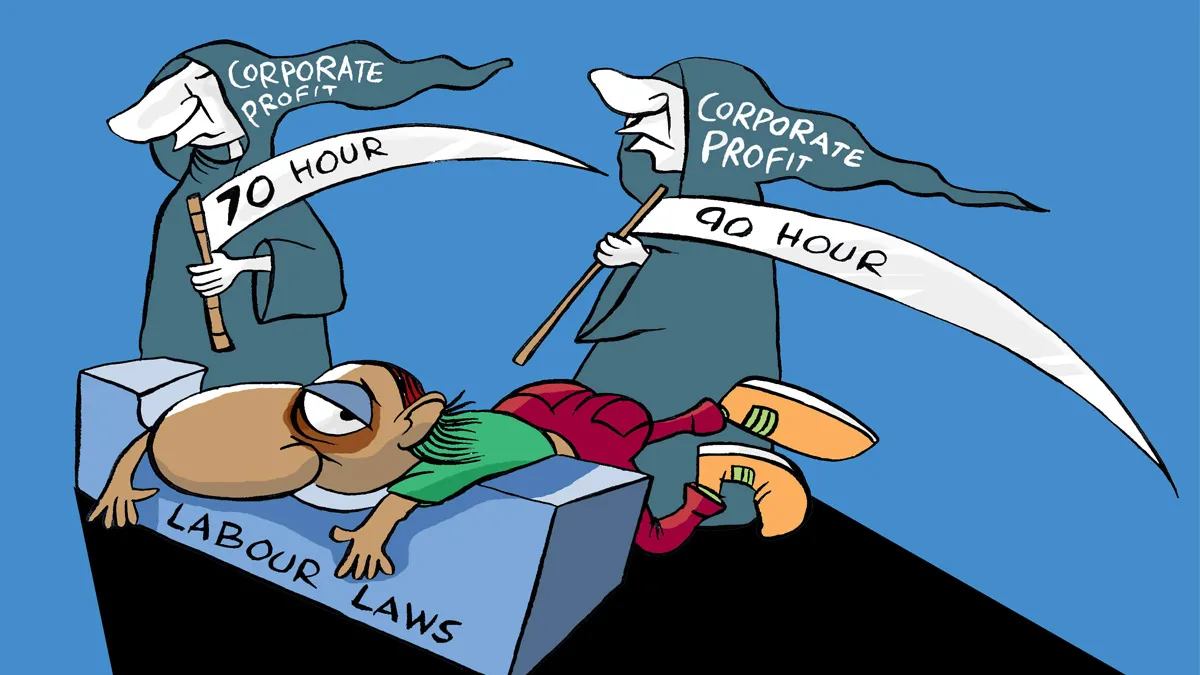
The Indian government is pressing all states and Union Territories (UTs) to publish their rules under the four new labour Codes by October 31, aiming to fully operationalise the new labour law framework. This move is crucial as labour falls under the concurrent list, requiring state-level rule-making for effective implementation.

Indian boxers Sakshi Chaudhary (51kg) and Jadumani Singh (55kg) have both advanced to the pre-quarterfinals of the Asian Games. Chaudhary secured an upset victory over Paris Olympics bronze-medallist Aira Villegas, while Singh dominated his opponent, Chandra Bahadur Thapa, to move into the next round.

The Indian government has introduced a 0.4% fee on UPI transfers above Rs 2,000 made to merchants, effective October 15, ending nearly six years of free merchant payments. This move led to initial rallies in fintech stocks like Paytm and Mobikwik, though some later pared gains. Person-to-person transactions and small payments remain free for customers, with the fee being a Merchant Discount Rate (MDR).

India's national security adviser was in Dhaka for roughly three-quarters of the day on Thursday to prepare the ground for Bangladesh Prime Minister Tarique Rahman's visit to New Delhi.

India's economy is projected to lose momentum in the second half of fiscal 2026-27, with tighter financial conditions, elevated energy prices, and broadening inflation pressures posing significant risks, according to DBS Bank economist Radhika Rao.
Airtel Africa's mobile payments arm, Airtel Money, has filed for an initial public offering (IPO) on the London Stock Exchange, with the International Finance Corporation (IFC) agreeing to purchase shares worth up to $90 million at the final offer price.

India's market regulator, Sebi, is set to issue a consultation paper proposing changes to the methodology for determining settlement prices of derivative contracts, following significant feedback and 'sharp price spikes and distortions' observed during the recently implemented Closing Auction Session (CAS) mechanism.

One of the important topics of discussion between the two leaders is expected to be the Northern Sea Route and the Chennai-Vladivostok Maritime Corridor.

Prime Minister Narendra Modi conveyed to Chinese President Xi Jinping that peace and tranquillity along the frontier remains an "essential" basis for the development of India-China relations, even as the two leaders welcomed "steady progress" in bilateral ties during their talks on the sidelines of the BRICS summit.
Commerce Secretary Rajesh Agarwal highlighted the critical need for India to diversify its services exports beyond the dominant IT/ITeS and professional services sectors. Speaking at the Global Fintech Fest 2026, he emphasised the vast potential in the global financial services market, where India currently holds a small share, and stressed how fintech solutions, like UPI, can drive growth, reduce remittance costs, and support MSME trade finance, ultimately leading to sustainable economic expansion.

J R D Tata, chairman of the Tata group from 1938 to 1991, said that whenever he had to make a difficult decision, he would ask himself, what will be good for India, and what will be good for the Tatas. If he had a doubt, he would decide in favour of India. In the long run, it would turn out well for the Tatas too, he said, points out Arun Maira.

Chinese President Xi Jinping's upcoming visit to India for the BRICS summit is a pivotal diplomatic event poised to significantly impact bilateral ties and global cooperation amidst ongoing international instability.
The Telecom Regulatory Authority of India (Trai) has mandated that service providers offer voice-and-SMS-only tariff plans, without bundled data, with a minimum validity of 30 days or less, aiming to provide more affordable and shorter-duration options for consumers who do not require data.

'The way the government behaves, sometimes I ask myself: Are not Tamils Sri Lankans too? Why do you discriminate so much?'

The Reserve Bank of India (RBI) is planning to extend tokenisation to various financial asset classes, building on its successful trials with certificates of deposit (CDs). This move aims to enhance the efficiency of issuance, trading, and settlement of financial assets, leveraging blockchain technology and wholesale Central Bank Digital Currency (CBDC) for atomic settlements.

Iranian President Masoud Pezeshkian arrived in New Delhi for the BRICS summit, where he is scheduled to hold bilateral talks with Prime Minister Narendra Modi to enhance trade and strengthen overall relations. His visit is particularly significant given the heightened tensions in West Asia and recent US economic sanctions against Iran. Pezeshkian highlighted BRICS' role in fostering economic resilience and reducing dependence on the US dollar, while the summit itself aims to address global challenges and bolster collective resilience in critical sectors.

Senior Congress leader Shashi Tharoor has articulated India's position on BRICS, advocating for it to be a "non-West, but not anti-West" platform, a stance he believes is crucial for India's national interest. He highlighted the prestige of hosting the BRICS summit, India's responsibility to represent the Global South, and the significance of bilateral meetings, particularly with China and Russia. Tharoor also addressed the strained India-China relations, citing border issues and trade leverage, and discussed the challenges within BRICS, including difficulties in achieving consensus on global issues and trade imbalances, while also considering the need for diversified international relations amidst unpredictable US sanctions.

CPI(ML) Liberation general secretary Dipankar Bhattacharya has strongly criticised the newly introduced Merchant Discount Rate (MDR) on select UPI transactions, labelling it a "UPI tax" and demanding its immediate rollback. He drew parallels with demonetisation, arguing that the new framework would negatively impact small shopkeepers, MSMEs, and ordinary citizens by increasing prices.

New capital exposure norms implemented by the Reserve Bank of India (RBI) from July 1 have led to a noticeable drop in trading volumes, with Multi-Commodity Exchange (MCX) options premium ADTV falling by nearly 40 per cent in early July.

Indian equity benchmark indices Sensex and Nifty rebounded sharply in early trade, with the Sensex jumping over 530 points, tracking a broad-based rally in Asian markets after four consecutive days of decline.

Russian President Vladimir Putin has arrived in India for a three-day visit to attend the BRICS summit and hold bilateral talks with Prime Minister Narendra Modi, focusing on expanding trade, investment, and energy cooperation amidst global geopolitical challenges.

The RSS-affiliated Swadeshi Jagran Manch (SJM) has urged the government to reconsider imposing a merchant discount rate (MDR) on UPI transactions above Rs 2,000, arguing that the costs do not warrant such a move. This comes after the government announced a 0.4 per cent fee on merchant transfers over Rs 2,000 from October 15, while assuring that person-to-person and small payments remain free. SJM co-convener Ashwani Mahajan highlighted that banks have not demanded MDR and that UPI has reduced their transaction costs.

Shares will be allocated across different institutional investors, including domestic mutual funds, other domestic institutions and FPIs.
